

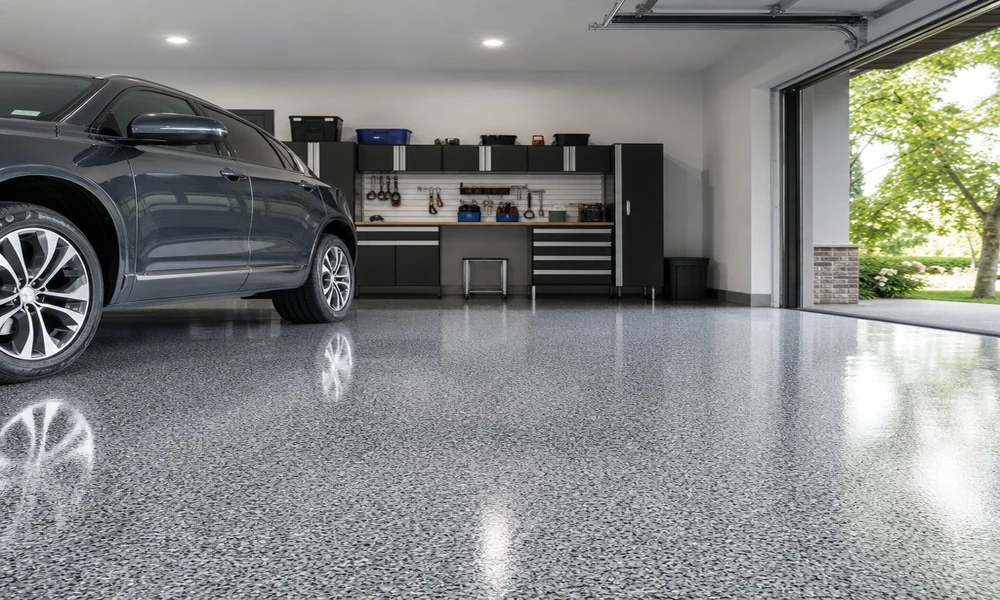
A garage floor is subjected to much harsher conditions than most other floors in a house. Cars roll across it, tools and objects are dropped on it, oil and water spill on it, and dirt is brought in on tires. Bare concrete doesn’t look great under all this abuse, but an epoxy finish can convert a flat, absorbent surface into a more resilient one that’s simpler to keep clean.
How Epoxy Improves Concrete Floors
Epoxy consists of resin and hardener. These two ingredients react to form a hard, adhesive coating once they are mixed and applied to the right type of concrete. Ordinary floor paint doesn’t have the same level of resistance to peeling, scuffing, staining, or denting.
Because the epoxy doesn’t have any seams or cracks, there are fewer nooks and crannies for dust and dirt to collect. In addition, liquid spills don’t soak into the concrete immediately; they sit on top of the surface for a little while, giving you time to wipe them up. For many homeowners, a garage epoxy coating is an appealing option for parking cars, storing belongings, doing projects, and running a workshop.
Proper Concrete Prep Is Vital
Before you even start mixing epoxy, your concrete must be cleaned, dry, structurally sound (browse around this site) and able to accept a good bond. Oil, sealants, old finishes, and loose material will inhibit proper adhesion.
Prep usually entails:
- Moving everything out of the garage and vacuuming it
- Degreasing areas stained by automotive fluids
- Fixing holes, pits, and cracks
- Scarifying or shot-blasting the concrete
- Vacuuming the concrete again to remove any leftover grit
- Testing the concrete for moisture issues
You might think it’s easier to skip some of these steps and go ahead with the epoxy, but chances are good you’ll end up with bubbles, delamination, or other types of failure. If the concrete is new, it may need to cure longer before you can put a finish on it.
Selecting Your Garage Epoxy
A garage epoxy floor doesn’t have to look the same as every other one. You can opt for a solid color, which gives you a consistent color throughout the space. Or you can choose a decorative flake option, which adds some interest to the floor and can also camouflage minor dirt and wear. There are also different finishes that can affect how bright or shiny your garage looks.
Decorative flake finish on an epoxy garage floor
Slip resistance is another thing to consider. A high-gloss finish may get slippery when wet, particularly around vehicles and doors. A slip-resistant additive can be added to help with traction, but it may make the floor harder to sweep and mop.
When choosing a garage epoxy floor, think about how you will use your garage. If you mostly use it for parking, you might want something that’s resistant to chemicals and tire marks. If you have a lot of workshops and projects in there, you may prefer something that’s resistant to impacts and has a contrasting color so that lost screws and nails are easier to find.
Applying and Curing Epoxy
Once you combine the two parts of epoxy, you have a short window to apply it. Plan ahead. Most professionals start at the edges of the garage and work their way in, finishing one section at a time. Any decorative additives need to be placed while the coating is still wet.
Ambient temperature, humidity, airflow, and the condition of the concrete itself can all affect how the epoxy cures. The floor may feel dry, but it might not be ready for heavy objects or car traffic yet. Following the manufacturer’s instructions regarding curing times can help prevent tire marks, dings, and other types of damage.
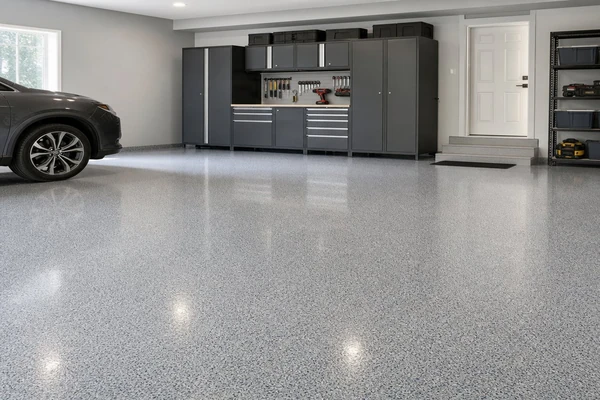
Applying epoxy coating evenly across a prepared garage floor
Maintaining Your Garage Epoxy Floor
It doesn’t take much to maintain an epoxy garage floor. Sweep or vacuum away grit and debris often, then mop with a soft mop and a nonabrasive cleaner (there is a useful breakdown at https://www.goodhousekeeping.com/home/cleaning/). Even though epoxy is resistant to many chemicals, you should still clean up automotive fluids as soon as possible. Dragging heavy equipment across the surface can cause scratches, so pads or castors are helpful. You may also want to check the floor from time to time to see if there are any chips or worn areas that need repairing.
The sunlight may slowly fade certain types of epoxy if it’s exposed in a garage with an open door.
If the floor is getting direct sun, you might want to add a UV-protective topcoat to keep the color from fading and provide extra protection from scuffs and scrapes.
A Floor That Can Handle Your Garage
An epoxy garage floor can give you a cleaner, shinier, more functional garage. However, it can only do what it was intended to do if you use the right product, prep your concrete properly, let it cure fully, and perform basic maintenance. When done correctly, a garage epoxy floor will last a long time and look good doing it.
